







Category: Money & Side Hustles

  • Stop Learning, Start Selling, The Fastest Path to Your First $500 Online

    Stop Learning, Start Selling, The Fastest Path to Your First $500 Online

    You already know enough. The problem isn’t your skills.

    I once bought 14 courses in a single year.

    Copywriting. SEO. Facebook ads. Email marketing. Funnel building. WordPress development. Each one promised transformation. Each one sat in my downloads folder, collecting digital dust.

    Course completion rate for most online programs? Between 5% and 15%.

    That means for every 100 people who buy a course, only 5 to 15 actually finish it. The rest? They move on to the next shiny thing. The next promise. The next “complete system.”

    I was one of them.

    And I bet you are too.


    The Addiction Nobody Talks About

    The self-improvement market is worth over $41 billion. Millennials spend up to $300 per month on personal development products. Courses. Books. Coaching. Apps.

    Yet 80% of people who set goals give up by February.

    Something doesn’t add up.

    Here’s the uncomfortable truth: learning feels productive. Buying a course feels like progress. Finishing a tutorial feels like accomplishment.

    But none of it pays the bills.

    Programmers call this “tutorial hell.” You watch videos. You follow along. You feel like you’re learning. Then you try to build something on your own and realize you can’t.

    Because following instructions isn’t the same as solving problems.

    And consuming content isn’t the same as creating value.


    The Real Reason You Keep Buying Courses

    I used to think I needed more knowledge.

    More certifications. More frameworks. More strategies.

    What I actually needed was permission. Permission to charge money for something I already knew how to do.

    Nobody gives you that permission. Not your parents. Not your employer. Not the course creator selling you the next level of their program.

    You have to give it to yourself.

    And the fastest way to do that? Make your first $500.

    Not $10,000. Not $5,000. Just $500.

    That first $500 breaks the spell. It proves that someone, somewhere, will pay you real money for something you can do.


    The Brutal Math of Learning vs. Earning

    Let’s do the math.

    Average course: $200. Average time to complete: 20 hours. Completion rate: 10–15%.

    So you spend $200 and 20 hours. You finish maybe 15% of the content. Then you buy another course.

    Compare that to selling.

    Time to send your first pitch: 10 minutes. Cost: Free. What you learn: Whether your skill is actually valuable.

    One hour of outreach teaches you more about the market than 20 hours of video content ever will.

    Because the market doesn’t care about your certificates. It cares about results.


    What You Already Know Is Enough

    Stop for a second.

    Think about what you did at work last week. Or what friends ask you to help with. Or what comes easy to you but seems hard to others.

    That thing you just thought of? Someone will pay for it.

    Not maybe. Not someday. Right now.

    A freelance developer I know started making money within two weeks of learning basic web development. He wasn’t an expert. He just knew slightly more than the small business owners who needed help.

    That’s the bar. Slightly more than the person paying you.

    You’ve probably already cleared it.


    The 7-Day Challenge to Your First $500

    Here’s a simple plan. No courses required.

    Day 1: Pick one skill.

    Not three. Not five. One.

    Something you’ve done before. Something you could do tomorrow if someone asked. Website setup. Social media management. Writing. Data entry. Canva graphics. Spreadsheet cleanup. Literally anything.

    Write it down.

    Day 2: Find 10 people who need it.

    Go to Facebook groups. LinkedIn. Local business directories. Upwork. Fiverr.

    Find 10 people or businesses who have the problem you can solve. Don’t overthink this. Just find 10.

    Day 3: Write a simple offer.

    One sentence. One price. One outcome.

    “I’ll set up Google Analytics for your website for $150. Done in 48 hours.”

    “I’ll write 4 blog posts for $400. Delivered in one week.”

    “I’ll create 30 days of social media posts for $300.”

    That’s it. No fancy sales page. No logo. No website.

    Day 4–6: Send 5 messages per day.

    Contact those 10 people. Then find 10 more. Then 10 more.

    Most won’t respond. Some will say no. That’s fine. You’re looking for one yes.

    The average freelancer gets their first client within a few weeks to a few months. But the ones who reach out consistently? They find clients faster.

    Day 7: Close one deal.

    If someone says yes, deliver exactly what you promised. Maybe even a little more.

    Get paid. Get a testimonial.

    Congratulations. You just made your first money online.


    Why $500 Changes Everything

    Your first $500 does something no course ever will.

    It proves you can do this.

    Not theoretically. Not eventually. Right now.

    That proof rewires your brain. Suddenly you’re not a student. You’re a service provider. You’re someone who gets paid for what they know.

    From there, the path forward is obvious.

    Repeat the process. Raise your prices. Find better clients. Build systems.

    But none of that happens until you make the first sale.


    The Course Industry Doesn’t Want You to Know This

    Here’s what course creators rarely tell you:

    They didn’t learn their skill from a course. They learned it by doing.

    Then they packaged that experience and sold it to you.

    You can skip the middle step.

    Start doing. Make mistakes. Learn from actual clients instead of hypothetical case studies.

    The skills you develop by selling are worth more than any certificate. Pitching. Negotiating. Delivering under pressure. Handling difficult clients. Managing your own time.

    No course teaches those.


    What Happens After $500

    Let me tell you what happened after I stopped buying courses.

    I made my first $500 from a simple website setup. Took me a weekend.

    That $500 became $1,000. Then $2,000. Then consistent monthly income.

    Not because I learned more. Because I finally started applying what I already knew.

    The same skills I had for years. The same knowledge that was gathering dust while I chased the next course.

    It was already enough.


    The Hardest Part Isn’t the Skill

    The hardest part is believing you deserve to be paid.

    It’s sending that first message without knowing if you’re “ready.”

    It’s naming a price and not apologizing for it.

    It’s showing up as someone who provides value, not someone who’s “still learning.”

    You’ll never feel ready. Nobody does.

    But you can feel $500 richer this month.

    And that’s a much better feeling than finishing another course.


    Your Move

    Here’s what I want you to do right now.

    Close this article.

    Open a new tab.

    Write down one skill you could sell tomorrow.

    Find one person who might need it.

    Send one message.

    That’s it.

    Not a course. Not a webinar. Not a 47-step funnel.

    One message.

    Because the gap between “learning” and “earning” isn’t knowledge.

    It’s action.

    And action is free.


    Stop learning. Start selling. Your first $500 is waiting.

  • The $0 Business Model Nobody Talks About in 2026

    The $0 Business Model Nobody Talks About in 2026

    Why the best time to start a business is when you have nothing to lose.

    I started my first online business with $0.

    Not $100. Not $50. Literally zero dollars.

    No website hosting. No fancy software. No business cards. No logo designer.

    Just a laptop, a WiFi connection, and a few hours on a Saturday afternoon.

    That business made its first sale within 48 hours.

    And I’m not special. I just discovered something most people overlook.

    The Secret Nobody Wants You to Know

    Here’s the truth the startup world doesn’t advertise:

    You don’t need money to start making money online.

    Not anymore.

    The tools that cost thousands of dollars five years ago? Free now. The platforms that required technical skills? Point and click. The distribution channels that demanded ad budgets? Built-in audiences waiting for you.

    The barrier to entry has collapsed. But most people haven’t noticed.

    They’re still saving up. Still “preparing.” Still waiting for the “right time.”

    Meanwhile, people with zero capital are building businesses that generate thousands every month.

    The Math That Changes Everything

    Digital products have profit margins of 70% to 90%.

    Let me say that again.

    For every $100 you make, you keep $70 to $90.

    Compare that to physical products where you’re lucky to keep 20% after inventory, shipping, and returns.

    Digital products cost almost nothing to create. Nothing to store. Nothing to ship.

    You make it once. Sell it forever.

    The global ebook market alone hit $18 billion in 2025. Online courses? Even bigger. Templates, printables, digital art? Exploding.

    And the best part?

    The tools to create and sell them are free.

    The Free AI Stack That Replaces a $50,000 Team

    Let me walk you through what’s available right now. For $0.

    Writing and Content: ChatGPT has 800 to 900 million weekly active users. The free version writes, edits, brainstorms, outlines, and helps you create content that would take a professional copywriter hours.

    Design: Canva’s free tier includes AI-powered design tools. Create ebook covers, social media graphics, presentations, and templates. No design skills required.

    Images: Leonardo AI gives you 150 daily credits to generate images. Product mockups, illustrations, digital art. All free.

    Video: CapCut dominates free video editing. AI removes silences, generates captions, and creates professional content.

    HeyGen offers free AI avatar videos. You can create talking-head content without ever showing your face.

    Audio: ElevenLabs provides free AI voice generation. Turn text into professional voiceovers.

    Five years ago, this stack would have cost you $2,000 per month minimum.

    Today? $0.

    The Platforms That Let You Sell for Free

    Creating the product is half the battle. Selling it is the other half.

    Good news: that’s free too.

    Payhip: Over 130,000 sellers use this platform. Free plan includes unlimited products, unlimited revenue, and all features. They take 5% per sale. That’s it.

    Ko-fi: Started as a tip jar. Now it’s a full storefront. Sell digital downloads, memberships, and commissions. Zero fees on donations. 5% on product sales. Or $6 per month for zero fees on everything.

    Gumroad: The original creator platform. Simple, clean, trusted. 10% flat fee on sales. No monthly cost.

    No website needed. No technical skills. No upfront investment.

    Upload your product. Set your price. Share your link.

    Done.

    What Can You Actually Sell?

    Here’s where people get stuck.

    They think they need a revolutionary idea. A unique concept. Something nobody has ever done.

    Wrong.

    The most profitable digital products are simple. Obvious. Even boring.

    Templates: Notion templates. Spreadsheet templates. Social media templates. Resume templates.

    One creator sells a simple budget spreadsheet on Etsy for $5. She’s made over $200,000 from it.

    Ebooks: Not 300-page novels. Short, practical guides.

    “How to meal prep in 2 hours.” “A beginner’s guide to houseplants.” “The freelancer’s tax checklist.”

    20 to 30 pages. Solves one specific problem.

    Printables: Planners. Checklists. Wall art. Coloring pages. Wedding invitations.

    Create once in Canva. Sell forever on Etsy.

    Mini-courses: Not 40-hour masterclasses. Quick, focused training.

    “Set up Google Analytics in 30 minutes.” “Create your first email sequence.” “Design Instagram posts that convert.”

    Record your screen. Talk through the process. Upload to a free platform.

    AI prompts: This is the newest category. People will pay for well-crafted prompts that save them time.

    ChatGPT prompts. Midjourney prompts. Automation templates.

    The format doesn’t matter. What matters is solving a real problem for a real audience.

    The 7-Day $0 Launch Plan

    Here’s exactly how to go from nothing to selling in one week.

    Day 1: Pick your product.

    What do people ask you for help with? What do you know that others don’t? What problem can you solve in a simple format?

    Write it down. One sentence. “I will create a [product type] that helps [audience] do [specific outcome].”

    Day 2: Research the market.

    Go to Gumroad. Etsy. Creative Market.

    Search for similar products. What’s selling? What do the reviews say? What’s missing?

    Don’t copy. Improve.

    Day 3: Create the product.

    Use ChatGPT to outline your content. Use Canva to design it. Use free tools to make it look professional.

    Don’t overthink. A good product shipped is better than a perfect product stuck in your head.

    Day 4: Set up your store.

    Create a free Payhip or Ko-fi account. Takes 10 minutes.

    Upload your product. Write a clear description. Set your price.

    Start lower than you think. You can always raise prices later.

    Day 5: Create your sales page.

    Use the platform’s built-in tools. Include what the product is, who it’s for, what they’ll get, and why it works.

    Add a few mockup images. Make it look real.

    Day 6: Launch and share.

    Post on your social media. Share in relevant groups. Tell people what you made.

    Don’t be salesy. Be helpful. “I made this thing. It solves this problem. Here’s the link.”

    Day 7: Iterate.

    What feedback did you get? What questions came up? What can you improve?

    The first version is never the best. That’s okay. Ship it anyway.

    Why Most People Won’t Do This

    I could give you every tool, every step, every strategy.

    Most people still won’t start.

    Not because it’s hard. Because it’s uncomfortable.

    Putting something out there. Asking for money. Being visible.

    That’s scarier than spending years “preparing.”

    But here’s what I’ve learned:

    The fear of starting never goes away. You just learn to act anyway.

    Your first product might flop. Mine did.

    Your second might do okay. Mine did.

    Your third might surprise you. Mine did too.

    But you’ll never get to the third if you don’t ship the first.

    The Real Cost of Waiting

    Every month you don’t start is a month of potential income you’ll never get back.

    Every “I’m not ready” is a sale that went to someone else.

    Every “I need to learn more first” is another excuse disguised as preparation.

    The tools are free. The platforms are free. The only cost is your time.

    And time is the one thing you can’t get more of.

    What Happens After Your First $100

    Something shifts when you make your first sale.

    Suddenly, you’re not a person thinking about starting a business.

    You’re a person who sells digital products.

    That $100 becomes $500. Then $1,000. Then recurring monthly income.

    Not because you got lucky. Because you started.

    Because you shipped something imperfect to an imperfect market and let reality teach you what no course ever could.

    Your Move

    You have everything you need.

    Free tools to create. Free platforms to sell. Free distribution through social media.

    The only thing standing between you and your first digital product sale is action.

    Not money. Not skills. Not time.

    Action.

    So here’s my challenge:

    Seven days from now, have something for sale.

    It doesn’t need to be perfect. It doesn’t need to be revolutionary. It just needs to exist.

    Because the $0 business model only works if you actually start.

    And the best time to start was yesterday.

    The second best time is right now.

    The barrier is gone. The tools are free. What are you waiting for?

  • 5 One-Person Businesses That Will Dominate 2026 (No Experience Needed).

    5 One-Person Businesses That Will Dominate 2026 (No Experience Needed).

    I used to think you needed years of experience to make real money.

    A fancy degree. The right connections. Maybe a business loan.

    Then I watched a 23-year-old make $4,000 a month from faceless YouTube videos about history. He had no film background. No media degree. Just a laptop and too much free time.

    That changed how I saw everything.

    The numbers tell a different story now.

    In 2024, people filed 5.2 million new business applications in the US. That is according to the US Census Bureau.

    Here is the surprising part.

    More than 81% of those businesses had zero employees. Just one person running the show.

    Nearly half started with less than $5,000.

    And 77% were profitable in their first year. That comes from Gusto’s 2025 survey of new business owners.

    Read that again. More than three out of four people who started a solo business made money in year one.

    These were not MBAs or tech wizards. Many were regular people who learned one skill and sold it.

    The game has changed. AI does the heavy lifting now. Platforms handle the hard stuff. You just need to pick something and start.

    Here are five business models working right now. You do not need experience for any of them.

    1. Faceless Content Channels

    You do not need to show your face to build an audience online.

    Some of the biggest YouTube channels have no person in front of the camera. No face. Sometimes no voice. Just good content.

    Think about channels that explain psychology. Or break down business stories. Or share true crime. Many use stock footage, simple text on screen, and AI voiceovers.

    The creator stays hidden. The content does the work.

    This is not a small trend. Faceless content makes up 38% of new creator businesses in 2025.

    Why does this work?

    People care about value. If your video teaches them something useful, they do not care what you look like. They care about what they learned.

    AI made this much easier. ChatGPT can write your script. ElevenLabs can do your voiceover. Stock footage sites give you visuals. You put the pieces together.

    Real numbers from real channels.

    Daily Dose of Internet makes $138,000 to $388,000 per month. 5-Minute Crafts earns around $38 million per year. Smaller channels report $2.50 to $12 per 1,000 views depending on the topic.

    What you need to start.

    A topic you find interesting. Basic editing skills. You can learn in a weekend. Consistency to post regularly.

    Cost to start is under $100. Free tools exist for everything.

    The best part. If your first channel fails, start another. Nobody knows it was you.

    2. Digital Products

    You do not need to be an expert to sell something online.

    You just need to know a little more than the person buying. Or save them time. Or organize information they could find but do not want to spend hours gathering.

    Digital products include ebooks, templates, checklists, planners, spreadsheets, Notion dashboards, Canva templates, and mini courses.

    The profit margins are crazy. Most digital products run at 70% to 95% profit. You make it once. You sell it forever. No inventory. No shipping.

    The creator economy hit $250 billion in 2025. Goldman Sachs says it will reach $480 billion by 2027. Digital products are a huge part of that growth.

    The trick is being specific.

    “Productivity template,” is too vague. Nobody searches for that.

    “90-Day Content Calendar for Instagram Coaches,” speaks to a real person with a real problem. That sells.

    What you need to start.

    One problem you can solve. Canva for design. Gumroad or Etsy to sell.

    Cost to start is almost nothing. Just your time.

    How much can you make. Anywhere from $500 to $10,000 or more per month. One creator shared making $15,000 on Gumroad in 2025 selling prompt packs and ebooks.

    AI helps with research and first drafts. But products that sell still need your human touch. People can tell when something was made with care.

    3. AI-Assisted Services

    This is where things get interesting.

    Tasks that used to need years of training. A beginner with the right AI tools can do them now. Not perfectly. But good enough to deliver real value.

    Writing blog posts. Managing social media. Creating email sequences. Editing videos. Making graphics. Doing research.

    Over 40% of virtual assistants now use AI tools for their work. The virtual assistant market is growing to $44 billion by 2027.

    Here is how it works.

    You find businesses with a problem. You offer to solve it. You use AI to do the heavy lifting. You add the quality control and human judgment that AI cannot provide.

    You are not pretending to be something you are not. You are combining your brain with AI power to get results.

    Services that work right now.

    Social media management brings $1,000 to $3,000 per month per client. Blog writing pays $100 to $500 per post. Email marketing runs $500 to $2,000 per month per client. Virtual assistance goes for $25 to $50 per hour.

    What you need to start.

    Basic knowledge of AI tools. Good communication skills. Willingness to learn as you go.

    Cost to start is under $50 per month for AI subscriptions.

    Important mindset shift. You are not selling hours. You are selling results. If AI helps you write ten blog posts in the time it used to take for two, you charge for ten blog posts.

    4. Newsletter Monetization

    Social media followers are rented. Email subscribers are owned.

    This matters more every year. Algorithms change. Platforms limit your reach. What worked last month stops working.

    But when someone gives you their email. You have direct access. No algorithm decides if they see your message.

    There are 207 million content creators in the world now. But only 4% make over $100,000 a year. The ones breaking through are building direct relationships with their audience.

    A newsletter is simple.

    Pick a topic. Write every week. Build an audience. Make money through sponsorships, paid subscriptions, affiliate links, or selling your own stuff.

    Among top-earning creators in 2025, newsletters were the main platform for 35%. That beat YouTube at 27% and Instagram at 24%.

    Ways to make money.

    Sponsorships where brands pay to reach your audience. Paid subscriptions where readers pay $5 to $15 per month for premium content. Affiliate marketing where you recommend products and earn commissions. Your own products like courses, templates, or consulting.

    What you need to start.

    A topic you can write about weekly. Patience. Newsletters grow slow but steady.

    Cost to start is zero. Most platforms are free until you grow.

    How much can you make. A newsletter with 10,000 subscribers where 5% pay $10 per month equals $5,000 per month. Add sponsorships and you double that.

    5. Micro-Consulting

    You do not need to be a world-class expert to give advice.

    You just need to be a few steps ahead of the person asking.

    Micro-consulting means small, focused advice sessions. One-hour calls. Quick audits. Specific feedback on one problem.

    This works because it is low risk for the buyer. They are not paying $5,000 for a big consulting package. They are paying $100 to $300 for a focused conversation that solves their immediate problem.

    5.6 million independent workers made over $100,000 in 2025. That number grew 19% from the year before.

    Examples that work.

    Resume reviews for job seekers. Website feedback for small business owners. Content strategy audits for creators. Pitch deck reviews for founders. Pricing strategy calls for freelancers.

    You do not need ten years of experience.

    If you have freelanced for two years, you know more than someone starting today. If you built one successful Etsy store, you know more than someone who built zero.

    What you need to start.

    One area where you can help others. A simple booking system. Courage to put yourself out there.

    Cost to start is under $50. Many booking tools are free.

    How much can you make. 10 calls per month at $150 each equals $1,500. Raise your prices as demand grows.

    People pay for speed. They could figure it out themselves. But they would rather pay someone to shortcut the process.

    What all five have in common.

    No formal credentials needed.

    Almost no money to start.

    Each one works better in 2026 than it would have five years ago.

    AI and platforms removed the barriers. The playing field is more level than ever.

    But here is what separates people who make money from people who stay stuck.

    They start before they feel ready.

    They pick one thing and commit instead of researching forever.

    They treat their first attempt as practice, not a make-or-break moment.

    That 77% profitability rate is real. Those people did not have a secret advantage. They just started while everyone else was still planning.

    Your turn.

    You do not need to quit your job.

    You do not need permission.

    You do not need another course.

    You need to pick one of these five and take one step this week.

    Make one faceless video. Create one digital product. Write one newsletter. Book one consulting call. Land one AI-assisted client.

    One is enough to prove it works.

    2026 is already here. Are you going to participate or watch from the sidelines.

  • ChatGPT Won’t Build Your Business. But Using It Like This Will.

    ChatGPT Won’t Build Your Business. But Using It Like This Will.

    I wasted three months.

    Every morning I opened ChatGPT. Typed random prompts. Got random results.

    “Write me a marketing email.”

    Generic garbage.

    “Create a business plan.”

    Sounded impressive. Said nothing.

    I kept blaming the tool. Maybe ChatGPT wasn’t that good. Maybe the hype was fake.

    Then I watched a friend use the same tool.

    Same ChatGPT. Same free version.

    But his results looked like they came from a $5,000 consultant.

    That’s when I realized something uncomfortable.

    The tool wasn’t broken. My approach was.


    The Lie Everyone Believes

    Here’s what most people think:

    Type a prompt. Get magic output. Copy. Paste. Done.

    That’s not how it works.

    700 million people use ChatGPT every week. That’s 10% of the global adult population. But most of them are using it wrong.

    They treat it like a slot machine.

    Pull the lever. Hope for a jackpot.

    And when the output is mediocre, they blame the machine.


    What I Was Doing Wrong

    Let me show you my old prompts:

    “Write a blog post about branding.” – Too vague.

    “Give me marketing ideas.” – No context.

    “Help me with my business.” – Help with what exactly?

    Vague in. Vague out.

    ChatGPT doesn’t read minds. It predicts the next best word based on what you give it.

    Give it nothing specific. Get nothing useful.

    I was asking a powerful tool to guess what I wanted. And then getting frustrated when it guessed wrong.


    The Shift That Changed Everything

    I stopped treating ChatGPT like a search engine.

    Started treating it like a new employee.

    Think about it.

    If you hired someone tomorrow, you wouldn’t say: “Do marketing.”

    You’d say: “Write a 500-word email for small business owners who are frustrated with their current website. Keep it friendly but professional. End with a clear call to action for a free consultation.”

    That’s the difference.

    Context. Audience. Tone. Goal.

    The more specific you are, the better the output.


    The System That Actually Works

    After months of trial and error, I landed on a simple framework.

    It’s not complicated. But it works.

    Step 1: Define the persona.

    Tell ChatGPT who to be.

    “Act as a conversion copywriter with 10 years of experience.”

    “You are a business strategist who works with solopreneurs.”

    This single line changes everything.

    Step 2: Give context.

    Who is this for? What’s the situation? What problem are we solving?

    Don’t assume ChatGPT knows your business. It doesn’t. Feed it the details.

    Step 3: Break it into phases.

    Never ask for a finished product in one shot.

    Instead:

    • First prompt: Brainstorm ideas
    • Second prompt: Pick the best one and outline it
    • Third prompt: Write the first section
    • Fourth prompt: Refine and improve

    This iterative approach beats one-shot prompts every single time.

    Step 4: Review and refine.

    ChatGPT gives you a draft. Not a final product.

    A study by Nielsen Norman Group found that professionals using ChatGPT spent less time writing rough drafts and more time polishing final output.

    That’s the secret.

    Less time creating. More time editing.

    The AI proposes. You decide.


    What the Numbers Say

    This isn’t just theory.

    Businesses using ChatGPT properly are seeing real results:

    • 59% productivity boost in document writing tasks
    • 40-60 minutes saved per day by employees
    • Companies using structured prompts report 3-5x better outputs
    • Cisco cut code review times by 50%
    • Octopus Energy now handles 44% of customer inquiries with AI

    The tool works. But only when you use it right.


    The Mistakes That Kill Your Results

    Let me save you some pain.

    Here’s what doesn’t work:

    Copy-paste-publish without editing. ChatGPT hallucinates. It makes things up. Always fact-check.

    One-shot prompts for complex tasks. Break it down. Build it up.

    Treating it like Google. It’s not a search engine. It’s a thinking partner.

    No persona or audience. Generic input equals generic output.

    Replacing your thinking. Use it to enhance your ideas, not avoid having them.


    What Actually Moves the Needle

    Here’s what works:

    Specific prompts with context, audience, and goals.

    Iterative conversations, 3-5 exchanges, not one.

    Using it for drafts, not finals.

    Building templates you can reuse.

    Human oversight on every output.

    The businesses winning with AI aren’t the ones using it the most.

    They’re the ones using it the smartest.


    A Prompt That Actually Works

    Let me give you something practical.

    Instead of: “Write a marketing email.”

    Try this:

    “Act as a direct response copywriter. Write a 300-word email for small business owners who are struggling to get leads from their website. Tone: friendly, helpful, not salesy. Include one specific tip they can implement today. End with a soft call to action to book a free 15-minute call.”

    See the difference?

    Persona. Audience. Problem. Tone. Length. Structure. Call to action.

    That’s how you get output you can actually use.


    The Real Opportunity

    Here’s what most people miss.

    ChatGPT won’t build your business for you.

    It won’t replace strategy. It won’t replace creativity. It won’t replace the hard work of understanding your customers.

    But it will multiply your output.

    It will turn a 2-hour task into a 30-minute task.

    It will help you think through problems faster.

    It will give you a first draft when you’re staring at a blank page.

    That’s the real value.

    Not magic. Multiplication.


    Your Move

    Stop blaming the tool.

    Start building a system.

    Pick one task you do every week. Email writing. Content creation. Research. Anything.

    Create a prompt template for it. Include persona, context, audience, and goal.

    Use it. Refine it. Make it better.

    In 30 days, you’ll have a library of prompts that actually work.

    And you’ll wonder why you ever used ChatGPT the old way.

    If you want to skip the trial-and-error phase, I put together two resources that helped me build this system:

    ChatGPT for Busy People: 30 Copy-Paste Workflows That Save 10+ Hours a Week — Ready-to-use workflows for everyday tasks. No guessing. Just copy, paste, and get results.

    ChatGPT Side Hustle Prompt Playbook — If you’re building something on the side, this one’s specifically designed to help you move faster without burning out.

    The tool is ready.

    The question is: are you?


    What’s the one task you wish ChatGPT could help you do better? Drop it in the comments, I’ll share a framework that helps.

  • The ‘Boring’ Business Model Quietly Making Millionaires in 2026

    The ‘Boring’ Business Model Quietly Making Millionaires in 2026

    Everyone is chasing the next big thing.

    AI startups. SaaS products. Crypto ventures.

    Your LinkedIn feed is full of founders announcing funding rounds. Your Twitter timeline celebrates the latest unicorn valuation. Everyone seems to be building something that will change the world.

    And somewhere in the back of your mind, you feel like you are falling behind.

    But here is what the data actually shows.

    90% of startups fail. Tech startups have a 63% failure rate within five years. AI startups fail at a 90% rate. Crypto ventures fail 95% of the time.

    Now here is a number that should make you stop and think.

    Laundromats have a 94.8% success rate over five years. With 90% of customers being repeat business.

    The business nobody talks about has a 95% chance of working. The business everyone admires has a 10% chance.

    Something is very wrong with our definition of smart business.


    The Quiet Millionaires

    Codie Sanchez worked at Goldman Sachs, Vanguard, and State Street. She built First Trust’s billion-dollar Latin America business. She had the career everyone envies.

    In 2015, she bought a laundromat for $25,000.

    People thought she was crazy. Why would someone from high finance buy a place where people wash clothes.

    Today she owns 26+ boring businesses. Her net worth is estimated at $17.7 million. Her platform Contrarian Thinking has over 2.5 million subscribers. Her book “Main Street Millionaire” became a New York Times bestseller.

    She did not build an app. She did not disrupt anything. She bought businesses that solve simple problems people face every single day.

    And she is not alone.

    In October 2024, the Wall Street Journal published an article titled “America’s New Millionaire Class: Plumbers and HVAC Entrepreneurs.”

    Private equity firms have purchased over 800 HVAC, plumbing, and electrical companies since 2022. According to data from PitchBook, they are paying 7 to 8 figure buyouts to ordinary business owners.

    The US HVAC sector alone has over 100,000 privately owned businesses. Private equity sees gold where most people see grease and sweat.

    These are not lottery winners. These are people who built simple service businesses over 10 to 15 years. They showed up. Did the work. Served their customers. Then someone wrote them a check that changed their family’s future forever.


    Why Boring Wins

    The answer is simpler than you think.

    Recurring revenue. A laundromat customer comes back every week. A self-storage renter stays for years. An HVAC maintenance contract renews annually. A commercial cleaning company has monthly contracts. This predictability makes planning easier and reduces the constant pressure to find new customers.

    Essential services. People can skip your productivity app. They cannot skip a broken pipe or a dead air conditioner in summer. Demand for essential services remains steady regardless of economic conditions or tech trends.

    Low competition. Nobody dreams of owning a septic tank business. That is exactly why the margins are incredible. Most entrepreneurs chase exciting industries. That leaves more opportunity in unglamorous work.

    Simple operations. No constant product updates. No pivots based on user feedback. No chasing product-market fit for years. A laundromat needs machines, maintenance, and a clean space. The operations do not change dramatically over time.

    The numbers back this up.

    A single laundromat can generate $20,000 to $100,000 per month with 20-40% profit margins. Self-storage facilities with 300+ units can bring in over $100,000 monthly with minimal staff. Commercial cleaning services can start with just $2,000 to $50,000 in startup costs. Vending machine operators report making $700,000 per year working two days per week.

    The commercial cleaning market alone was valued at $182 billion in 2023 and is expected to grow to $277 billion by 2032. That is not a niche. That is a massive opportunity hiding in plain sight.


    The Real Problem

    You have been told success requires disruption.

    Build something exciting. Find investors. Scale fast. Get featured in TechCrunch.

    But that path has terrible odds.

    Only 0.7% of startups receive equity funding from venture capitalists. Of those, only 8% succeed. That brings the combined success rate to roughly 0.05%. About 1 in 2,000.

    75% of VC-backed startups never return a single dollar to their investors.

    Meanwhile, the plumber down the street is building generational wealth. Nobody writes articles about him. Nobody features him in podcasts. But his business has been profitable for 15 years and private equity just offered him $3 million.

    The boring business model offers something different.

    Higher success rates. Predictable revenue. No investors needed. No permission required. Freedom to build at your own pace.

    It will not get you featured in TechCrunch.

    But it might actually work.


    How to Start

    This is not complicated.

    Find a service everyone needs in your area. Car washes. Laundromats. Cleaning companies. Storage facilities. HVAC services. Plumbing. Pest control.

    Look for weak competition. Industries where existing players provide poor service. Where customers complain but have no alternatives. Where showing up on time and doing quality work would make you stand out.

    Consider buying instead of building. Many boring business owners are approaching retirement age. Their children do not want to take over. They would rather sell to someone who cares than watch their life’s work disappear.

    Laundromats typically sell for 4 to 6 times annual net revenue. Many sellers will even finance part of the deal themselves.

    Start where you can. Not everyone can buy a $200,000 laundromat. But cleaning services can start with $2,000 to $50,000. Vending machines can start with a few thousand dollars. Pressure washing requires minimal equipment.

    The key is entering a market with proven demand and building from there.


    Work Smarter Not Harder

    Building any business takes time and energy. The smart move is to automate the repetitive stuff so you can focus on what actually matters.

    I put together ChatGPT for Busy People: 30 Copy-Paste Workflows that save 10+ hours every week. Whether you are running a boring business or building something else, these workflows handle the tasks that drain your energy. Emails. Research. Content. Planning. All the stuff that eats your day without moving the needle.

    Work smarter so you can build faster.


    The Bottom Line

    The quiet millionaires figured something out.

    They chose cash flow over clout. Freedom over status. Boring over brilliant.

    They own laundromats, storage facilities, plumbing companies, and cleaning services. They solve unglamorous problems. They collect predictable revenue. They build equity year after year.

    They will never trend on social media.

    But they sleep well at night.

    And they are building real wealth while everyone else chases the next shiny thing that has a 90% chance of failing.

    The most profitable path is rarely the most exciting one.

    Maybe it is time to reconsider what smart really looks like.

  • I Stopped Writing ChatGPT Prompts From Scratch. Here’s What I Do Instead.

    I Stopped Writing ChatGPT Prompts From Scratch. Here’s What I Do Instead.

    Last Tuesday, I spent 47 minutes on a single email.

    Not writing it. Rewriting what ChatGPT gave me.

    The AI spit out something generic. Corporate fluff. The kind of email that sounds like it was written by a robot pretending to be human.

    So I tweaked my prompt. Tried again. Got something worse.

    Tweaked again. Better, but still not right.

    By the time I had something usable, I’d wasted nearly an hour. On one email.

    That’s when I realized something uncomfortable.

    I wasn’t saving time with AI. I was creating extra work.


    The Problem Nobody Talks About

    Everyone says ChatGPT is a productivity tool.

    They’re wrong.

    ChatGPT is a productivity tool if you know how to use it. For everyone else, it’s just a fancy way to generate rough drafts you’ll rewrite anyway.

    Here’s what most people do. They type a vague question. Get a generic answer. Spend 20 minutes fixing it. Repeat tomorrow.

    I did this for months. Thought I was being productive. Thought I was leveraging AI.

    I wasn’t.

    I was just adding steps to my workflow.

    According to a 2024 study by Nielsen Norman Group, users who write unstructured prompts spend 40% more time editing AI outputs than users who follow a consistent prompting framework. The time saved by AI gets eaten up by the time spent fixing what AI produces.

    That’s the trap.


    What Changed Everything

    I started paying attention to people who actually save hours with ChatGPT.

    Not the influencers posting screenshots. The quiet professionals who finish work early and don’t brag about it.

    They all do the same thing.

    They don’t write prompts. They reuse them.

    They have systems. Templates. Workflows they copy, paste, customize in 30 seconds, and get usable output immediately.

    No thinking. No rewriting. No wasted time.

    The difference isn’t talent. It’s preparation.


    The Anatomy of a Prompt That Actually Works

    Most prompts fail because they lack structure.

    Bad prompts are vague. “Help me write an email.” “Give me ideas for my project.” “How do I be more productive.”

    These prompts force ChatGPT to guess what you want. And when AI guesses, it defaults to generic.

    Good prompts have four elements.

    First, context. Tell ChatGPT who you are and what situation you’re in. “I’m a project manager at a software company” gives the AI something to work with. Without context, you get advice written for nobody in particular.

    Second, specificity. Include concrete details, not vague descriptions. “A client who hasn’t responded in 5 days” is specific. “A client who’s being slow” is vague. Specific inputs create specific outputs.

    Third, format. Define exactly how you want the output structured. Do you want bullet points or paragraphs? A formal tone or conversational? Three options or one recommendation? If you don’t specify, ChatGPT will choose for you. And it usually chooses wrong.

    Fourth, constraints. Set boundaries. Word count. Things to avoid. Tone requirements. Constraints force the AI to focus instead of rambling.

    Here’s what this looks like in practice.

    Vague prompt: “Write a follow-up email”

    Structured prompt: “I sent a proposal to a potential client 5 days ago about redesigning their website. They seemed interested in our initial call but haven’t responded to my proposal. Write a follow-up email that references my original proposal without sounding desperate, adds one insight about why website speed affects their conversion rates, ends with a simple yes/no question to make responding easy, and stays under 100 words. Tone should be confident but respectful of their time.”

    The second prompt takes 45 seconds to write. But it saves 20 minutes of rewriting.

    That’s the trade-off most people miss. A little effort upfront eliminates a lot of frustration later.


    The Five Prompt Mistakes That Waste the Most Time

    After analyzing hundreds of my own failed prompts, I found five patterns that consistently produce bad outputs.

    Mistake one: No role assignment.

    ChatGPT performs better when you tell it who to be. “Act as a senior copywriter with 10 years of experience” produces different output than no role at all. The AI draws on different patterns depending on the persona you assign.

    Research from Anthropic and OpenAI confirms this. Role-based prompts activate more relevant training data, leading to more specialized responses.

    Mistake two: Asking for too much at once.

    Complex requests should be broken into steps. Instead of “Write me a business plan,” try “First, outline the five sections a business plan needs. Then we’ll tackle each one.”

    Chunking produces better results than cramming everything into one prompt.

    Mistake three: Not specifying what to avoid.

    Telling ChatGPT what you don’t want is as important as telling it what you do want. “Don’t use corporate jargon.” “Avoid exclamation points.” “Don’t start with ‘I hope this email finds you well.’”

    Constraints eliminate the generic filler that makes AI writing obvious.

    Mistake four: Accepting the first output.

    The first response is a starting point, not a final product. Follow up with “Make it shorter.” “More specific.” “Give me a different angle.” “Add an example.”

    Iteration is where the quality happens.

    Mistake five: Not providing examples.

    If you want a specific style, show ChatGPT what you mean. Paste an email you’ve written before. Share a paragraph you like. Say “Write in this style.”

    Examples are worth a thousand instructions.


    Why Systems Beat Skills

    You can learn prompt engineering.

    Read the guides. Watch the tutorials. Understand the theory.

    But theory doesn’t help at 9 AM when you’re staring at 47 unread emails and your brain hasn’t fully woken up yet.

    What helps is a system.

    Something you can copy. Paste. Fill in the blanks. Send.

    No thinking required.

    The best productivity advice I ever received was this: don’t rely on motivation. Rely on systems that work even when you’re tired.

    That applies to AI too.

    The people who get the most value from ChatGPT aren’t prompt engineering experts. They’re people with a library of proven prompts they reuse and refine.


    A Framework You Can Use Today

    Here’s a simple framework I use for any professional email. You can copy this and start using it immediately.

    Open ChatGPT and paste this:

    “You are a professional communication specialist. I need to reply to this email:

    [Paste the email you received]

    Context about me: I’m a [your job title] at a [company type]. My relationship with this person is [describe: client, colleague, boss, vendor].

    Write a response that acknowledges their main points, answers any questions they asked, and ends with a clear next step. Keep it under [number] sentences. Tone should be [friendly/formal/warm but professional].

    Avoid exclamation points. Avoid corporate jargon. Avoid starting with ‘I hope this email finds you well.’”

    Fill in the brackets. Send the prompt. Get a usable reply in seconds.

    This single workflow has saved me hours every week. No more staring at blank screens. No more rewriting robot-speak.


    The Math That Convinced Me

    Let’s say you save 20 minutes per day using better prompts.

    That’s conservative. One email, one planning session, one decision-making framework.

    20 minutes multiplied by 5 days equals 100 minutes per week.

    100 minutes multiplied by 50 weeks equals 5,000 minutes per year.

    That’s 83 hours. Two full work weeks. Recovered. Every year.

    Not by working harder. By copying and pasting smarter prompts.

    When I calculated this for my own workflow, the number was closer to 10 hours per week. That’s 500 hours per year. Twelve and a half work weeks.

    The ROI on good prompts is absurd.


    Building Your Own Prompt Library

    If you want to build your own system, start small.

    Identify the three tasks you do most often that involve writing or thinking. For most people, that’s email, planning, and decision-making.

    Create one reusable prompt for each task. Write it once. Save it somewhere accessible. A notes app, a Google Doc, wherever you can find it quickly.

    Use it for a week. Refine it based on what works. Add more prompts as you identify more repetitive tasks.

    Within a month, you’ll have a personal library that saves you hours.

    The key is starting with workflows, not theory. One prompt that works teaches you more than ten articles about prompt engineering.


    What I’d Tell My Past Self

    Stop treating ChatGPT like a search engine.

    Stop typing random questions and hoping for good answers.

    Stop rewriting AI outputs that should have been right the first time.

    Start building systems. Templates. Workflows you can reuse.

    Or better yet, start with workflows someone else already built and tested.


    The Shortcut

    Building your own prompt library takes time. Testing what works. Refining what doesn’t. Figuring out the right structure for different tasks.

    I spent months doing this.

    You don’t have to.

    I compiled everything I use into a single playbook. 30 workflows covering email, planning, learning, and decision-making. Each one follows the structure I outlined above. Each one is copy-paste ready.

    There’s also a 30-day implementation plan so you actually build the habit instead of letting another resource collect dust.

    One workflow will pay for the entire thing. The first time you skip a 20-minute email rewrite, you’ve made your money back. Everything after that is profit in time, energy, and sanity.

    Get the ChatGPT Playbook here

    Stop prompting from scratch. Start copying what works.


    What task wastes most of your time with ChatGPT? Share in the comments and I’ll point you to a framework that helps.

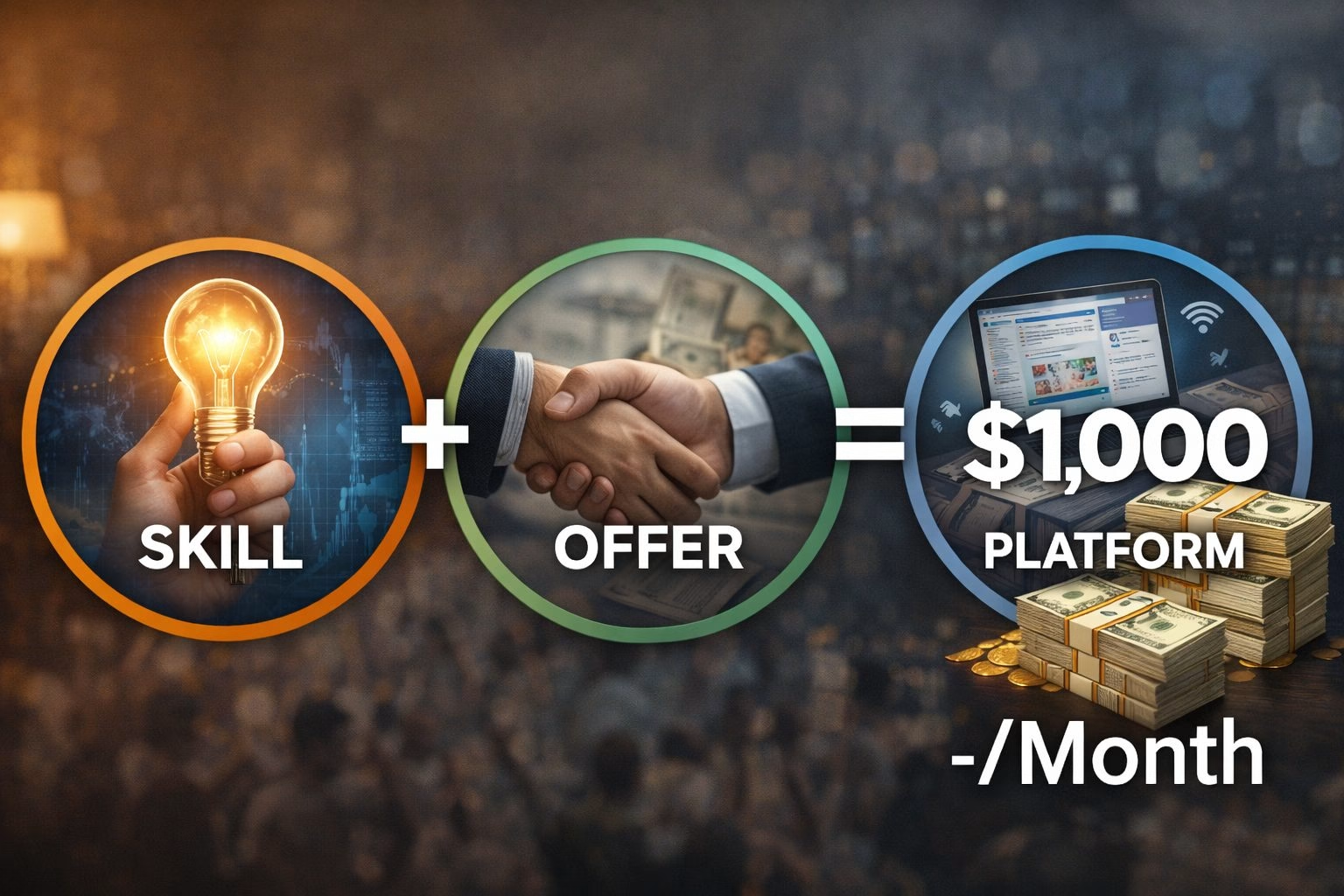
  • One Skill, One Offer, One Platform, The Simplest Path to $1K/Month

    One Skill, One Offer, One Platform, The Simplest Path to $1K/Month


    I used to think making money online was complicated.

    Learn ten different skills. Be on every platform. Offer everything to everyone.

    I had a Fiverr profile. An Upwork account. A website. A Facebook page. An Instagram. A LinkedIn.

    I was offering web design. SEO. Social media management. Content writing. Logo design. Email marketing.

    I was everywhere doing everything.

    And I was making almost nothing.


    One day I sat down and did the math.

    I had spent three months spreading myself thin. I had made maybe 200 dollars total.

    That is less than 70 dollars a month.

    I was working harder than ever. But I was going nowhere.

    Something had to change.


    I decided to try something different.

    Instead of doing everything, I would do one thing.

    Instead of being everywhere, I would be in one place.

    Instead of offering ten services, I would offer one.

    One skill. One offer. One platform.

    That was it.


    Here is what happened.

    I picked web development. That was my strongest skill. The thing I could do better than most.

    I picked one offer. WordPress website setup for small businesses. Nothing else. Just that.

    I picked one platform. Fiverr. I deleted my other profiles. I stopped posting on Instagram. I focused everything on one place.

    Within two months I was making more than I had made in the previous six months combined.

    Not because I got smarter. Not because I learned something new.

    Because I stopped spreading myself thin.


    Most people who struggle to make money online have the same problem.

    They are doing too much.

    They think more is better. More skills means more opportunities. More platforms means more visibility. More offers means more clients.

    It sounds logical. But it does not work that way.

    When you do too many things, you do none of them well.

    When you are on too many platforms, you are not really present on any of them.

    When you offer everything, people do not know what you actually do.

    You become invisible.


    Let me explain why one skill works better than five.

    When you focus on one skill, you get better at it faster. You learn the shortcuts. You understand the problems. You know what clients actually want.

    After doing the same thing fifty times, you can do it in your sleep.

    But if you are jumping between five different skills, you never get deep enough. You stay average at everything. And average does not get paid well.

    Specialists make more money than generalists. That is just how it works.


    Now let me explain why one offer works better than ten.

    When someone lands on your profile and sees ten different services, they get confused.

    Is this person a writer or a designer? Do they do websites or social media? Are they an expert or just someone who does random stuff?

    Confusion kills sales.

    But when someone sees one clear offer, they know exactly what they are getting. There is no guessing. No wondering. Just clarity.

    And clarity converts.


    Here is why one platform works better than five.

    Every platform has its own rules. Its own algorithm. Its own way of doing things.

    To succeed on Fiverr, you need to understand how Fiverr works. How to write gig descriptions. How to rank in search. How to handle clients.

    To succeed on Upwork, you need to understand proposals. How to bid. How to build your profile score.

    To succeed on Instagram, you need to understand content. Hashtags. Reels. Engagement.

    Each platform is a full time job to master.

    When you are on five platforms, you master none of them. You are always a beginner everywhere.

    When you focus on one platform, you learn how it works. You figure out the tricks. You become better than the people who are spread too thin.

    That is when you start winning.


    Let me show you the simple math.

    Say you want to make 1,000 dollars a month.

    If you charge 100 dollars per project, you need 10 clients.

    If you charge 200 dollars per project, you need 5 clients.

    If you charge 500 dollars per project, you need 2 clients.

    Two clients a month. That is not a lot. That is very doable.

    But you will never get those two clients if you are running around trying to do everything everywhere.

    You will get them by being focused. By being known for one thing. By being easy to find in one place.


    Here is how I would do it if I were starting today.

    Step one. Pick your skill.

    What can you do that other people struggle with? What do people ask you for help with? What comes easy to you but seems hard to others?

    It does not have to be fancy. It does not have to be unique. It just has to be useful.

    Writing. Design. Video editing. Data entry. Social media. Website setup. Customer support.

    Pick one. Just one.


    Step two. Create your offer.

    Do not say you do everything. Say you do one specific thing for one specific type of person.

    Bad offer: I do graphic design.

    Good offer: I create Instagram post designs for small clothing brands.

    Bad offer: I build websites.

    Good offer: I set up WordPress websites for local service businesses.

    See the difference? The second one is specific. It tells people exactly what they get and who it is for.

    Specific offers attract better clients.


    Step three. Pick your platform.

    Where are your potential clients already looking for help?

    If you want to do freelance services, pick Fiverr or Upwork or PeoplePerHour. Just one.

    If you want to do local business work, pick LinkedIn or direct outreach. Just one.

    If you want to sell digital products, pick Gumroad or Etsy. Just one.

    Do not try to be everywhere. Pick one platform and learn how it works. Become good at that one place before you think about expanding.


    Step four. Show up consistently.

    This is where most people fail.

    They set everything up. Then they disappear for two weeks. Then they come back and wonder why nothing is happening.

    Consistency beats talent every time.

    On Fiverr, that means optimizing your gig, responding fast, and delivering great work.

    On Upwork, that means sending proposals every single day.

    On LinkedIn, that means posting and engaging regularly.

    Whatever platform you choose, show up every day. Do the work. Be patient.

    Results come to those who stay.


    Let me tell you what happens when you commit to this.

    Month one feels slow. You are learning. You are figuring things out. Maybe you get one or two small clients.

    Month two gets better. You understand the platform now. Your profile is stronger. You know what clients want.

    Month three is when things click. You have reviews. You have momentum. Clients start coming to you instead of you chasing them.

    By month four or five, you are at 1,000 dollars. Maybe more.

    Not because you got lucky. Because you stayed focused.


    I know this sounds too simple.

    One skill. One offer. One platform.

    Where is the fancy strategy? Where is the secret hack?

    There is no hack.

    The people making real money online are not doing anything complicated. They are doing simple things consistently.

    They picked one lane. They stayed in it. They got good.

    That is the whole game.


    You do not need to learn five new skills.

    You do not need to be on every platform.

    You do not need to offer everything to everyone.

    You need to pick one thing and commit to it for six months.

    That is it.

    One skill. One offer. One platform.

    The simplest path to your first 1,000 dollars a month.

    Stop overcomplicating it.

    Start today.

  • Stop Building an Audience, Start Building an Income

    Stop Building an Audience, Start Building an Income


    I wasted six months trying to grow my Instagram.

    Posted every day. Replied to comments. Used all the hashtags people told me to use.

    After six months I had 847 followers.

    Most of them never even saw my posts.

    I checked the numbers. Instagram shows your content to about 3 percent of your followers. That means out of 1,000 followers, only 30 people will actually see what you post.

    I was chasing numbers that meant nothing. And I was not making any money.


    Here is what everyone told me.

    Build your audience first. Get followers. Grow your page. Once you have thousands of people watching, then you can start earning.

    I believed this for a long time.

    It is wrong.

    Building an audience takes forever. It can take six months just to get your first 1,000 followers. And that is if you do everything right.

    Meanwhile you are making content for free. Hoping someone notices. Waiting for that magical day when you finally have enough followers to matter.

    That day might never come.


    Let me show you why this does not work.

    Say you work hard for six months and reach 1,000 followers. That is good. Most people give up before they get there.

    But with only 3 percent reach, maybe 30 people see your post. Maybe 10 of them care. Maybe 2 click your link.

    Two people.

    Six months of work.

    Still no money.

    Now think about someone else. They spent those same six months finding clients directly. Sending messages. Landing freelance work. Building real income.

    One person has followers. The other has cash.

    Which one do you want to be?


    There is a faster way.

    Instead of making content and hoping people find you, go to where the buyers already are.

    Freelance platforms. Direct messages. Places where people are already looking to pay for help.

    You do not need followers for this. You need a skill and the courage to offer it.


    Upwork. Fiverr. PeoplePerHour.

    These platforms have millions of people looking for help right now. They do not care about your follower count. They care if you can solve their problem.

    I have seen people make their first 500 dollars in weeks. Not months. Weeks.

    All they did was create a profile, write a clear offer, and start sending proposals.

    No audience needed.


    Or you can skip the platforms completely.

    Find businesses that need help. Send them a message. Offer your service.

    No fees. No competition from hundreds of other profiles. Just you and a potential client.

    A local restaurant needs someone to manage their social media. A small shop needs a simple website. A startup needs someone to set up their email marketing.

    These people are everywhere. They are not on your Instagram feed. They are in your inbox if you reach out.

    You do not need 10,000 followers to send a message to a business owner.

    You just need to hit send.


    There is another option too.

    Brands are paying people to make content for them. They call it UGC. User generated content.

    Here is the thing. You do not need any followers for this. None.

    Brands are not paying you for your audience. They are paying you for your content. They take what you make and post it on their own pages.

    Someone with zero followers can make money doing this. The brand gets good content. You get paid. Your follower count does not matter at all.


    The audience first model has a big problem.

    It assumes attention comes before income.

    But attention is not money. Attention is just potential.

    Potential does not pay your bills.

    When you flip it around and focus on income first, everything changes.

    You get paid. That gives you confidence. That confidence helps you create better content. That content starts to attract people naturally.

    But now you are building an audience while earning. Not while hoping and praying.

    The pressure goes away. You are not desperate anymore. You are creating from a place of strength.


    If I had to start over today, here is what I would do.

    Month one. Pick one skill. Make a profile on one platform. Send ten messages.

    Month two. Get my first client. Do great work. Ask for a testimonial.

    Month three. Raise my price a little. Use the testimonial to get better clients.

    Months four to six. Keep going. Build a system. Grow the income slowly.

    After I have money coming in consistently, then I would think about building an audience. Creating content. Sharing what I am learning.

    But I would do it from a stable place. Not a desperate one.


    If you have been trying to build an audience for months and you still have no money, ask yourself something.

    What if you flipped it?

    What if you stopped chasing followers and started chasing clients?

    What if you stopped waiting to be found and started reaching out?

    What if you stopped building an audience and started building an income?


    Building an audience is a long game. It can take years.

    Building income can happen in weeks.

    The people who make money online fast are not the ones with the biggest audiences. They are the ones who skip the audience thing completely and go straight to the buyers.

    Freelance platforms. Direct outreach. Client work.

    It is not glamorous. There are no viral moments. No screenshots to show off.

    But there is money in your account.

    And that is what actually matters.


    Stop scrolling. Stop planning. Stop waiting.

    Open Upwork or Fiverr today. Make a profile. Write what you can do. Send five proposals before you sleep.

    Or find five small businesses near you. Message them. Offer to help with something specific.

    You do not need followers.

    You do not need an audience.

    You just need to start.

    Build the money first. Build the audience later.

    Your first client is closer than your first 1,000 followers.

    Go get them.

  • The 1-Hour Side Hustle: How to Make Your First $100 This Week

    The 1-Hour Side Hustle: How to Make Your First $100 This Week

    The fastest path from zero to paid.


    I made my first $100 online in one afternoon.

    No website. No audience. No fancy tools.

    Just one skill, one message, and one person who needed help.

    It took less than an hour to set up. The rest was just waiting for a reply.

    That was the moment I realized something important. Making money online is not as complicated as people make it sound.


    The Myth of the Perfect Setup

    Most people never make their first dollar online because they think they need things they do not need.

    A professional website. A logo. A business plan. An audience. The perfect niche. The right tools.

    They spend weeks or months preparing. They research. They plan. They buy courses.

    And they never actually start.

    Here is what you actually need to make your first $100.

    One skill someone will pay for. One way to find people who need it. One message that explains what you do.

    That is it. Everything else can come later.


    The Numbers That Should Excite You

    There are over 76 million freelancers in the United States alone. By 2027, that number is expected to reach 86.5 million. That will be more than half the entire workforce.

    According to Upwork, freelancers earned $1.5 trillion in 2024. The average hourly rate for freelancers in the U.S. is around $48.

    But here is the number that matters most.

    Over 70% of freelancers find their work through online platforms and direct outreach.

    This means you do not need to be discovered. You do not need to go viral. You do not need to wait for opportunities to come to you.

    You can go find them. Today. Right now.


    The One-Hour Setup

    I am going to show you exactly how to set up a side hustle in one hour or less. This is not theory. This is a step-by-step system you can follow today.

    Minutes 1-15: Pick Your Skill

    Write down three things you know how to do that other people struggle with.

    This does not have to be something fancy. It does not have to be something you are the best in the world at. It just has to be something you can do better than the person paying you.

    Here are some examples.

    Writing emails that sound professional. Setting up spreadsheets. Editing photos. Managing social media accounts. Organizing files and folders. Proofreading documents. Creating simple presentations. Data entry. Basic research. Scheduling and calendar management.

    Pick one. Just one. You can always add more later.

    Minutes 15-30: Find Your First Platform

    You need a place where people are already looking for help. Do not try to build your own audience. Go where the buyers already are.

    Here are your options for getting started fast.

    Fiverr. You can create a gig and have it live within an hour. The platform has millions of buyers looking for services every day. Start with a low price to get your first reviews.

    Upwork. Create a profile and start sending proposals to jobs that match your skill. Most job posts receive dozens of proposals within 24 hours. Move fast.

    But these platforms are high competition now. But still you have chance of getting clients through them.

    LinkedIn. You already have connections. Some of them need help with things you know how to do. A simple post or direct message can land your first client.

    Local businesses. Look at businesses in your area. Check their websites. Check their social media. Many of them need help and do not know where to find it.

    Pick one platform. Create your profile or write your first message. Do not overthink it.

    Minutes 30-45: Write Your Offer

    Your offer needs to answer three questions.

    What do you do? Who is it for? What result do they get?

    Here is a simple template.

    I help [type of person] with [specific task] so they can [result they want].

    Examples.

    • I help small business owners write professional emails so they can close more deals.
    • I help busy professionals organize their files so they can find anything in seconds.
    • I help content creators edit their videos so they can post more consistently.

    Keep it simple. One sentence is enough to start.

    Minutes 45-60: Send Your First Messages

    This is the part most people skip. They set everything up and then wait for clients to find them.

    Do not wait. Go find them.

    If you are on Fiverr, optimize your gig title and description with words buyers are searching for. Then share your gig link in relevant communities.

    If you are on Upwork, send at least five proposals today. Personalize each one. Show you actually read their job post.

    If you are reaching out directly, send ten messages to people who might need your help. Keep the message short. Focus on their problem, not your credentials.

    The math is simple. If you send ten messages and one person says yes, you have your first client. If nobody says yes, send ten more tomorrow.


    The $100 Price Point

    When you are starting out, price is not about maximizing profit. It is about getting your first sale as fast as possible.

    Here is how to think about pricing.

    For a quick task that takes 1-2 hours, charge $50-100.

    For a small project that takes a few hours, charge $100-200.

    For ongoing work, charge weekly or monthly.

    Your first goal is not to get rich. Your first goal is to get paid. Once you have proof that people will pay you, you can raise your prices.

    The median hourly rate for freelancers is $28. If you charge $50 for a two-hour task, you are already above average.


    What to Do When Someone Says Yes

    Your first client will probably come faster than you expect. Here is what to do when it happens.

    Confirm the details. What exactly do they need? When do they need it? What format should the final work be in?

    Set expectations. Tell them when you will deliver. Give yourself a little buffer in case something takes longer than expected.

    Do excellent work. Your first client is not just paying you for a task. They are giving you a testimonial, a referral, and proof that your system works. Make it count.

    Ask for a review. After you deliver, ask them to leave a review on whatever platform you used. Those first few reviews make everything easier.


    The Real Bottleneck

    Most people think the hard part is finding clients. It is not.

    The hard part is sending the first message.

    The hard part is putting yourself out there before you feel ready.

    The hard part is risking rejection.

    I have talked to dozens of people who have all the skills they need to make money online. They know how to write. They know how to design. They know how to organize. They know how to solve problems.

    But they never send the message. They never create the profile. They never make the offer.

    They stay stuck at zero because taking action feels scarier than staying where they are.

    Here is what I want you to understand.

    The worst thing that can happen is someone says no. That is it. They say no, and you move on to the next person.

    The best thing that can happen is someone says yes, and your whole relationship with money changes forever.


    The $100 Snowball

    Your first $100 is not really about $100.

    It is about proof. Proof that you can do this. Proof that strangers will pay you. Proof that making money online is not just something that happens to other people.

    Once you have that proof, everything gets easier.

    Your second client comes faster than your first. Your third client comes faster than your second. You raise your prices. You get referrals. You build momentum.

    But none of that happens until you get the first one.


    Your One-Hour Challenge

    Here is what I want you to do today. Not tomorrow. Not next week. Today.

    Set a timer for one hour.

    In the first 15 minutes, pick your skill. Write it down.

    In the next 15 minutes, choose your platform. Create your profile or identify ten people to contact.

    In the next 15 minutes, write your offer. One sentence. What you do, who you help, what result they get.

    In the final 15 minutes, take action. Send messages. Submit proposals. Share your gig. Do something that puts you in front of potential clients.

    When the timer goes off, you will have a functioning side hustle. Not a perfect one. Not a polished one. But a real one that can actually make you money.


    The Question That Matters

    One year from now, you will either be glad you started today or you will wish you had.

    The skills you need to make $100 are the same skills you need to make $1,000. And $10,000. And beyond.

    The only difference is repetition.

    But you cannot repeat something you have never done.

    So do it once. Make it ugly. Make it imperfect. Make it real.

    Your first $100 is waiting. It is closer than you think.

    One hour. One skill. One message.

    Start now.

  • Why Your First $100 Online Matters More Than Your First $10,000

    Why Your First $100 Online Matters More Than Your First $10,000

    The small number that changes everything.


    I remember the day I made my first $100 online.

    It was not a pretty number. It was not a screenshot I could post on Twitter. Nobody would be impressed by it.

    But I sat there staring at my phone for ten minutes.

    Because something had changed.

    Not in my bank account. In my head.


    The Number Everyone Chases

    When people talk about making money online, they always mention the big numbers.

    Six figures. Ten thousand a month. Quit your job money.

    I used to chase those numbers too.

    I would read about someone making $50,000 from a digital product. I would watch videos about people earning $20,000 a month from freelancing. I would dream about the day I could post my own screenshot.

    But here is what nobody told me.

    The gap between $0 and $100 is bigger than the gap between $100 and $10,000.


    The Statistics Nobody Wants to Hear

    According to the U.S. Bureau of Labor Statistics, 20.4% of businesses fail in their first year. By the fifth year, 49.4% have closed. By the tenth year, 65.3% are gone.

    But those numbers hide something important.

    Most people never start at all.

    They dream. They plan. They research. They buy courses. They watch videos.

    But they never make that first sale.

    And here is the brutal part.

    Most people who do start quit after their first failure. They try once. It does not work. They assume they are not cut out for this.

    They never realize they might have been just a few more tries away from something real.


    What the First $100 Actually Proves

    When you make your first $100 online, you prove three things.

    First, you prove that someone will pay you. Not your mom. Not your friend doing you a favor. A stranger on the internet who decided your work was worth their money.

    Second, you prove you can do the hard parts. Finding clients. Pitching yourself. Delivering work. Handling rejection. Getting paid. These are skills that do not come from courses. They come from doing.

    Third, you prove that this is real. Not a fantasy. Not something that only works for other people. Real money in your real account.

    That proof changes everything.


    The Confidence Loop

    Research on entrepreneurial psychology shows something interesting.

    The more entrepreneurs succeed, the more confident they become. And the more confident they become, the more likely they are to succeed again.

    It is a loop. Success builds confidence. Confidence builds more success.

    But the loop has to start somewhere.

    For most people, it starts at $100.

    That first $100 is not about the money. It is about breaking the seal. It is about proving to yourself that you can do this thing that millions of people dream about but never actually do.


    Why Big Goals Kill Progress

    I know someone who wanted to build a $10,000 per month business.

    He spent six months planning. He bought three courses. He made a detailed spreadsheet. He designed a logo. He built a website.

    He never made a single sale.

    The goal was so big that every step felt too small. Why send five emails when you need to make $10,000? Why charge $50 when you need to charge $500?

    The big number paralyzed him.

    Here is what I have learned.

    Big goals are not motivating. They are terrifying. They make every small action feel pointless.

    Small goals create momentum.

    If your goal is $100, sending five emails feels like real progress. Charging $50 feels like you are halfway there. Every small win pushes you forward.

    $100 is achievable. It is close enough to reach. It is real enough to matter.


    The Math Nobody Does

    Let me show you something.

    If you can make $100 once, you can make $100 again.

    If you can make $100 twice, you can probably make $200.

    If you can charge $50 for something, you can probably charge $75 for the same thing.

    If one person paid you, another person will too.

    This is how every successful online business started. Not with a master plan. Not with a six-figure launch. With one sale. Then another. Then another.

    The people making $10,000 a month are not doing something fundamentally different from the person who made $100. They just did it more times. They got better at it. They raised their prices. They found more customers.

    But it all started with that first small number.


    What Most People Get Wrong

    Most people think they need to build something big before they can make money.

    They think they need a perfect website. A huge audience. A complete product line. A professional brand.

    They spend months building. Then they launch. Then nothing happens.

    Here is the truth.

    You do not need any of that to make your first $100.

    You need one skill. One offer. One person willing to pay.

    That is it.

    Everything else comes later. After you have proven the concept works. After you have real customers telling you what they actually want. After you have money coming in.


    The Fastest Path to $100

    If you want to make your first $100 online this month, here is what to do.

    Step one. Pick one thing you know how to do that other people struggle with. Writing. Design. Spreadsheets. Social media. Organizing. Editing. Teaching. Fixing things.

    Step two. Find ten people who might need that thing. Not millions of people. Ten. Look on LinkedIn. Look in Facebook groups. Look at local businesses with bad websites.

    Step three. Send them a message. Tell them what you do. Tell them how it helps. Tell them your price.

    Step four. When someone says no, send another message. When someone ghosts you, send another message. Keep going until someone says yes.

    Step five. Deliver the work. Get paid.

    That is the entire system. It is not complicated. It is not easy either. But it works.


    The $100 Mindset Shift

    Something happens in your brain when you make that first $100.

    Before, making money online was theoretical. Something other people did. A possibility.

    After, it becomes real. Something you have done. A fact.

    That shift matters more than any course. More than any strategy. More than any tool.

    Because once you know you can do it, you stop asking if and start asking how much and how often.

    CB Insights analyzed over 100 failed startups. The number one reason they failed? 42% said there was no market need for what they were selling.

    But here is the thing.

    You do not know if there is a market until you try to sell something. Planning does not tell you. Research does not tell you. Only real customers with real money tell you.

    Your first $100 is market research. It is proof that someone wants what you have.


    Stop Waiting for the Big Opportunity

    I wasted years waiting for the perfect idea. The big break. The opportunity that would change everything.

    It never came.

    What came instead was small opportunities. A $50 project here. A $75 task there. Tiny wins that added up.

    Those small wins taught me more than any course ever did. They showed me what people actually pay for. They showed me how to communicate value. They showed me how to deliver.

    By the time bigger opportunities came along, I was ready for them. Because I had practiced on the small ones.


    The Question That Changes Everything

    Stop asking how do I make $10,000 a month online.

    Start asking how do I make $100 this week.

    The first question leads to overwhelm. Too many options. Too many strategies. Too much information.

    The second question leads to action. One skill. One offer. One customer.

    Most people never make $10,000 a month because they never make $100 first.

    They skip the foundation. They chase the result without doing the work that creates it.


    Your Move

    Here is what I want you to do.

    Forget about the big number. Forget about quitting your job. Forget about financial freedom.

    Focus on $100.

    One hundred dollars from one stranger who decided your work was worth paying for.

    It is not glamorous. It will not change your life overnight. Nobody will be impressed when you tell them about it.

    But it will prove something important.

    You can do this.

    And once you know that, everything else becomes possible.